

Different Lives – Social Acceptance Level
Why our destinies are cut in stone and cannot be changed

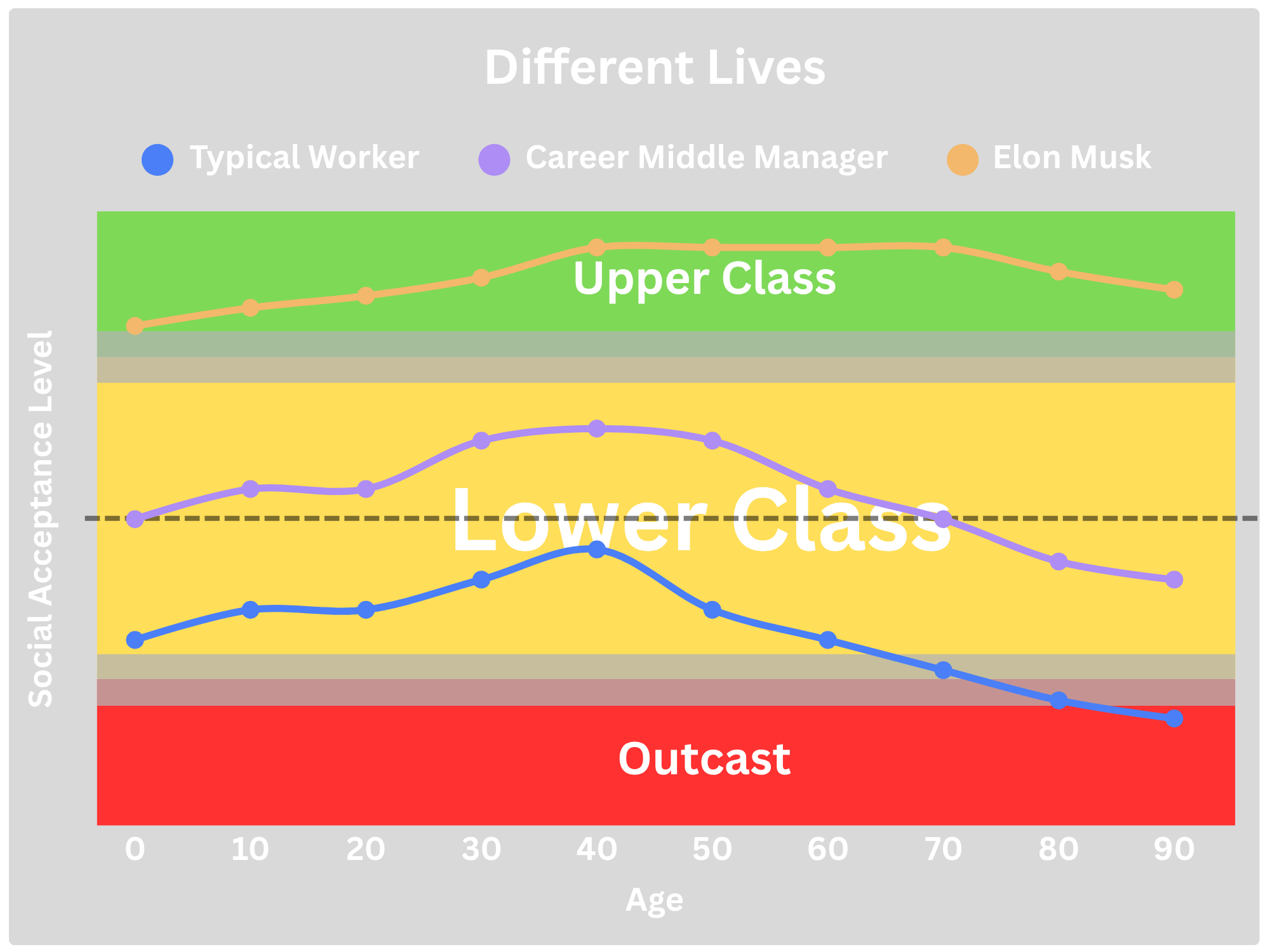
Popular success, social acceptance, or perhaps even a measure of “likeliness to be happy”. What I am talking about is how likely it is that people around you will take you seriously and consider you a valid member of society.
A high social acceptance level means that if you send a job application, it will be read and you will be considered a serious candidate. If you write a social media post, it will be read by many and people will be eager to comment. And if you publish a book, many will buy it because it is by you, no matter the topic and writing quality.
A low social acceptance level will, on the other hand, mean that you will be ruled out in many contexts, and people will be reluctant to do anything that would be considered kind or friendly – and they will be unlikely to hire you, or buy your book.
You see, social acceptance is not something certain. We have some people in all societies who are never really let in. They are at the bottom, and even though they may be treated nicely as part of some social improvement program run by charity organizations or government institutions, they will remain at the bottom. I call these “outcast”, because that’s effectively what they are. They are not part of society in the same way as we would consider most people to be. They don’t have the same opportunities.
But you are not home safe just by not being an outcast. Traditional economical/socialogical thinking will often group people into lower class, lower middle class, upper middle class, and upper class. This then relates to societal status, and is often measured by the help of economical metrics – assuming that wealthy people are higher in the hierarchy than poor people.
It often is like that, but the existence of such expressions like “new-rich” illustrates that money alone will not let people into the good company of the upper class. It takes more. Often, a gallery of famous people in the family tree will help.
With my definition of the “outcast” class, I have also taken the liberty to redefine the other classes a bit, to fit my purpose of describing the social acceptance level.
As I see it, there is a group of people similar to the traditional upper class, mostly being the same people, actually, that will be automatically accepted everywhere. They tend to get into good universities, get good jobs, get financial backup from their surroundings for whatever projects they engage with, and get moral and practical (coaching/teaching) backup to develop themselves and become stars of the society.
But the bulk of people are in the lower class, mostly corresponding to the traditional definition of the middle classes.
As I have seen it, most of those who do well in this segment are from families where others are also doing well. They are also, often, from certain geographical areas, and they have not been in the need to start from scratch but could get an education and focus on it, without needing a study job and without needing to keep justifying to their surroundings that this was a good way forward.
People who grow up with less impressive relatives, come from the outskirts of the society, geographically, and/or feel a negative pressure to stop studying and start working, for instance, they are not likely to climb to a high social acceptance level. They may improve, and it is typical, but they meet a steep decline when they are no longer young.
Elon Musk, Taylor Swift, Bill Gates, and many others in the upper class have never been near the lower class acceptance levels. They have allways, through their lives, met a significant amount of support from their surroundings, and they always will, for their remaining lives. In the diagram above, I have guessed on the development of Elon Musk, who is today in his mid-50s, and it is likely that he can maintain a high level for some time but will see it lower a bit when getting older.
That’s significant for the upper class: they stay on top during most of their adult lives and can have long careers with whatever they do. Some rock stars see a decline in success, then come back later, and this can even happen several times, like with Johnny Cash, who himself mentioned having had five come-backs, as far as I remember. But they are then typically not in the upper class, according to this schema. They are balancing somewhere around the top of the lower class and the bottom of the upper class.
It is difficult to find anyone who genuinely breaks this pattern. Lower level workers have short careers and end their lives end as a perceived burdon to society, while the higher level workers, the middle managers, often stay relevant a bit longer, and for instance can become relatively popular on social media, etc., because they have that aura of being at a higher acceptance level for the society.
Just for explaining the diagram:
The level is defined as 0-100, but there is no way to calculate this precicsely. I just considered different situations and the likeliness that people would listen to a given person and take the one seriously, being interested, for instance when applying for a job, giving a speech, or posting on social media.
People may of course become older than 90, but they then tend to continue the trend they are on, until they reach the end of their lives. It is very rare to see someone increase their level at that age, but basically, the higher you rank from the start, the less you will decline when you get older.
The border lines between the classes are not precisely defined, hence the grey areas between them.
The dashed line in the middle simply indicates that here is the middle of the diagram, and it has no further meaning.
The better half of the lower class tend to have longer career highs than the lower half. The upper class members basically stay on top during all of their adult lives.
I have not given any example of an outcast, but consider all people with disabilities, or having some properties that are less popular in a society, such as a different skin color or an unusual accent, to be typical candidates for that class. An immigrant with disabilities, who cannot have a normal job (as if anybody would ever offer them such one), will most often be found here. Nobody will ever listen to them, or take them seriously in any context. The trend for native members of this class is that they see a small upturn as children, due to the mentioned social programs, but they will most often not be lifted out of the outcast class.
There is an increased level of arrogance and negative push on people below. The higher people are ranked, the more they do that. This, probably, helps maintain the concept and the status quo – if all the middle managers see you as a lower ranking person, they will take that into their decisions about promotions, and in the communication with you and your colleagues. And it counts for everybody in society as well, even if they don’t know you. It is enough for them to know something about you, such as you have not been promoted. They trust your boss more than they trust you, because your boss is higher ranked.
This also means that anyone falling below the expected level, will meet a solid down-push from a lot of people – getting ill, getting fired, becoming disabled, whatever: that will lead to a drop in social acceptance. Think about how often you say “yes, that’s right, I will definitely follow that person” about someone who is unemployed, as compared to how often you do that about someone who is on top of society? It is not even about their skills in speaking or writing, it is about their status.
People look up to those who rank higher, and they look down on those who rank lower. And that is why this article will be read and liked by a few people only – most will prefer to go with the popular writers, liking their articles, perhaps in the hope that some of the rain that falls on the big ones will drip down on them.1
Now, the next thing I will start considering here, is what can actually be done. How can we climb a bit, even though we may not be able to jump to the next class? Because, climbing 10% means 10% better chances of being heard, whatever the context. 10% better chance to get a job, for instance. And that matters.
Maybe there’s nothing we can do, but then again, maybe there is something. First of all, we need to take the arrogance into consideration and try to avoid wasting out efforts on those who are too far away from our stance, since they will look at us as trash. Then we must find people who may be interested in us, for whatever reason and motivation – maybe they could potentially benefit from having us around, or reading what we write.
I guess that giving something useful is an element here. And, finally, age is a trigger for many movements up and down, but there are others. Finding out which, could potentially mean that we’ll know how to adjust the level a bit.
—oOo—
Where are you? What would your curve look like?
My curve is like the typical worker’s, except that I probably topped at around 30 and now am in the outcast class. Most people believe that I am valueless, and they see every single one of the many things I have done in my life as ridiculous or low-level, and as something “they could also have done”, and they often find it important to let me know that. They see me as a loser.2 I do experience an occasional positive valuation by others, but these have become rare – and I am somehow beginning to adapt to that: becoming what they see me as.
Have you experienced anyone who has been in a decline, according to the social acceptance level, and then managed to turn the curve upward again? What did they do to make that happen? Could this be done by others too, you think?
—oOo—
These thoughts are a continuation of those described in another article:
The Working Class... Hero?

For 57 years, almost – at least during most of my life, and that has lasted so many years, so far – I have believed that I was a human being, and that people around me also were human beings.
There is also a level of arrogance upwards, though. When some people are on the top, it will lead to contempt from some who a much lower. Perhaps this is the reason for some of the hate speech about the Big Tech bros, who are close to being seen as the main enemies of society by many.
Some don’t see me as a loser, and I am deeply greatful to those. It is what keps me alive. As K.Lynn Grey mentioned in a comment to the previous article in this series, “…a few good friends are worth more than fleeting popularity…” – which is true. My thoughts about the social acceptance level is not so much about the amount of social activity, as they are about the probability of people around you to support you. Both your friends and those who are further away from you. So, friends definitely add in with some important points toward a good level.
What you described is a kind of "social darwinism". Successful families are more likely to produce successful offspring. Mainly due to money, influence and legacy advantage. What I mean by legacy advantage is a student applying for university will have a greater chance of being accepted if some family members are alumni. Everybody doesn't start from the same starting line.
Sadly, the saying, "Nice guys finish last" has some truth to it. It takes a psychopathic and predatory mindset to be successful in this world. Hence, why most global and business leaders are just that. Being a nice guy or different or eccentric doesn't mean "loser".
It just means your value system doesn't align with the predator class. You've written great articles on substack and blame the algorithm 🙄 if you expected more subscribers. And as Stephanie said, of course you have value and are not a loser. Don't listen to the haters as all they do is detract.
Let it be said, you are NOT a loser and you are valuable. Our value as humans is a given - not something to be earned or validated through accomplishments and/or possessions.
What you do and write here is very valuable and I am grateful for your contributions...
About your observations in this article though: They shatter many illusions but are true, unfortunately :-(